How Painted Casino Backdrops Turn a Room into a Scene
Read painted casino backdrops more carefully by separating visible room details from theatrical symbols, and avoid treating a staged scene as local history.
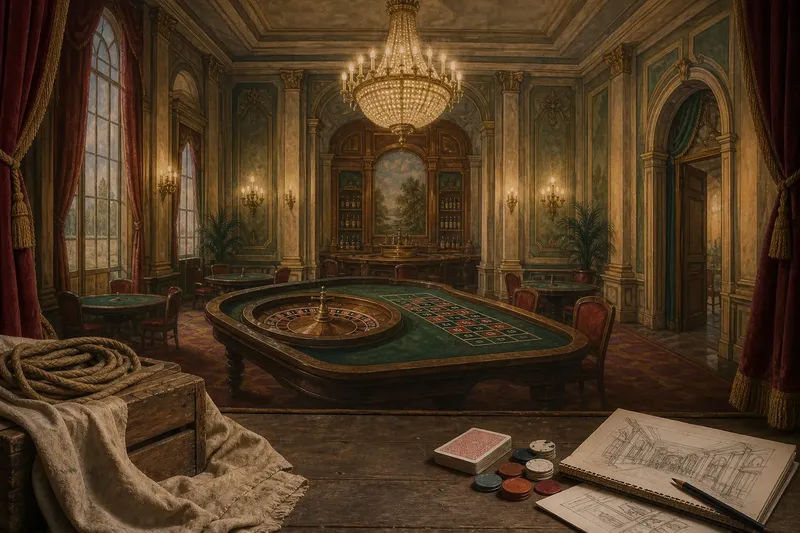
The common mistake when reading a painted casino backdrop is to treat its furniture as evidence of a real venue. That can lead you to assign a stage design to Casino Bến Nghé without proof. A painted room is first a theatrical construction: its doors, tables and lights are arranged to communicate with an audience.
To read one carefully, start with what the backdrop actually shows, then ask how its design serves the scene. A roulette table might establish the action; a false doorway might frame an entrance; an oversized chandelier might signal luxury. Those choices tell you about the image’s visual language, not automatically about a particular casino’s architecture or customs.
Painted casino backdrops organise the stage as a room
A backdrop gives performers a setting without building a complete interior. Painted walls, windows and columns can suggest depth, while the actors and movable props occupy the foreground. The result is a coordinated stage picture, not a floor plan.
Look at how the painted space relates to the action. A broad table placed near the centre can make gambling immediately legible from the audience. A painted doorway behind it may make arrivals and departures part of the scene. If the room’s perspective seems compressed or its furnishings are too large, that may help the image read across the theatre rather than record realistic dimensions.
Separate fixed scenery from objects that performers can handle. A painted card table belongs to the backdrop; a real deck of cards may be a prop. Their relationship can create a convincing scene, but it does not establish that the backdrop depicts an actual casino.
Read the backdrop’s theatrical details before assigning a location
Inspect the whole composition, not just the most recognisable gaming symbol. Note entrances, sightlines, seating, lamps and any signs. Then consider what each detail does: does it direct attention, make room for performers, or suggest a social setting?
For Casino Bến Nghé, local identification needs more than a roulette wheel or a dressed-up crowd. Look for specific evidence attached to the image, such as a legible venue name, a caption, a dated production record or a reliable provenance linking the design to that place. Without such evidence, describe what is visible and leave the location unresolved.
A useful analogy is a shop window: its display can suggest what a shop sells, but it does not show the full premises or prove where the shop stands. A painted casino room works similarly. It selects a few visible cues to make the scene understandable from the auditorium.
Use these checks to separate stage design from local history
- Check for a readable venue name. If the lettering identifies Casino Bến Nghé and can be read clearly, record it as visible evidence; if not, describe the sign as indistinct rather than naming the venue.
- Check the image caption or programme record. If it ties the backdrop to a named production and place, cite that link in your account; if it gives no such link, treat the setting as unidentified.
- Check which features are painted and which are movable props. If a table or doorway is part of the painted scene, discuss it as scenery; if it is a separate stage object, describe its role without attributing it to the backdrop.
- Check the perspective and scale. If walls, furniture or entrances are enlarged or compressed, read them as theatrical choices; if the image provides consistent spatial details, you may describe those details but still avoid claiming architectural accuracy without corroboration.
- Check for distinctive local clues. If several visible clues are independently tied to Bến Nghé by reliable documentation, explain that connection; if a cue is generic, such as cards or a chandelier, do not use it to identify the place.
- Check what the composition emphasises. If light and figures converge on a gaming table, describe the table as the scene’s focal point; if attention is spread across the room, explain how the broader setting shares the emphasis.
How can you interpret a painted casino backdrop?
Does a roulette wheel prove the scene shows a real casino?
No. It identifies a gaming activity or evokes casino imagery, but it does not identify a particular venue. Look for documentary or local evidence before attaching a place name.
How can you tell painted scenery from a stage prop?
Check whether the object is integrated into the flat backdrop or appears as a separate three-dimensional item in front of it. If the image does not make that distinction clear, describe the uncertainty rather than deciding by guesswork.
What details help identify Casino Bến Nghé?
A legible name or a documented connection between the image and the venue is more useful than generic gaming objects or formal dress. If no such link is available, keep the description focused on the visible scene.
A worked reading keeps observation separate from inference
Say you have an invented theatre image showing a painted room, a central gaming table, a doorway and an unclear sign. First, record those four visible details without naming a venue. Next, check the image’s accompanying programme: in this invented situation, it names a fictional production but no casino. Then inspect the sign: its letters remain unreadable. The resulting account can say that the backdrop stages a casino-like room around a central table, but it cannot identify the setting as Casino Bến Nghé. The trade-off is clear: you gain a precise description while leaving the location open.
When you write about painted casino backdrops, keep observation, interpretation and attribution distinct. State what the scenery contains, explain how its arrangement guides the audience, and name a real venue only when supporting evidence connects it to the image. That approach preserves the backdrop’s theatrical meaning without turning suggestive decoration into local history.