Casino Bến Nghé in Saigon’s Changing Language of Chance
Explore Casino Bến Nghé through Saigon’s histories, gambling customs and imagery, and learn to separate local context from fiction’s language of chance.
The common mistake with Casino Bến Nghé is to treat its name as a complete history. That shortcut can turn an uncertain subject into a ready-made image of glamour or risk. The name links the subject to Bến Nghé in Saigon, but the wording alone does not establish a venue’s location, dates, activities or reputation.
A careful account separates what a source actually says from what its reader might infer. That distinction matters when discussing gambling customs, the language of luck and images associated with casinos: each can reflect cultural meaning without proving how a particular place operated.
Use the name as a clue rather than proof
“Casino” can suggest a gaming venue, but its meaning depends on the period and context in which it appears. A reference might concern entertainment, commerce, regulation or social display. Do not assume that every use describes the same kind of institution.
“Bến Nghé” is a place-name, but a name alone cannot establish where a named venue stood or how people used it. To make those claims, look for evidence tied to a date and place, such as a map, a contemporary notice, a photograph with reliable provenance or a description that identifies the site.
Record the exact spelling, date and wording of each source. A map label, newspaper notice and memoir have different purposes; note what each can support instead of blending them into one seamless account. If a source repeats a later story, identify it as a later account rather than contemporary evidence.
Keep gambling practices distinct from ideas about luck
People may describe a lucky streak, a bad omen or a fortunate encounter. Such expressions can convey humour, hope, anxiety or a shared convention. They are evidence of how a speaker frames chance, not evidence that chance can be controlled.
Practices also depend on setting. A private game, a public entertainment and a regulated venue may carry different expectations about participation, conduct and reputation. Describe the specific practice a source records; do not turn one account into a claim about all Saigonese people or every period.
When a source mentions luck, ask who is speaking and what the phrase is doing. It may be a boast, a joke, a plea for reassurance or an explanation after an unpredictable outcome. Attribute the phrase to its speaker, and keep cultural interpretation separate from practical claims about gambling.
Read casino imagery for framing and omissions
Casino imagery can use contrasts such as bright interiors and dark streets, polished surfaces and tense faces, or spectacle and private calculation. These choices shape a viewer’s impression; they do not, by themselves, document everyday life at a particular venue.
Describe what an image visibly contains: perhaps a sign, doorway or crowd. Then record its caption, date and provenance separately. An image caption is like a label on a key: it may identify which door the object is meant for, but it cannot show what lies behind it.
If an image is presented as evidence of a specific event or building, check whether the identification is contemporary or was added later. Pair it with independent descriptions where available. If the link remains uncertain, say so rather than filling gaps with familiar casino imagery.
How can you assess a claim about Casino Bến Nghé?
What does the name alone establish?
It establishes the wording used to identify the subject and suggests a connection to the Bến Nghé place-name. It does not establish a precise address, the venue’s activities, its operating dates or its reputation.
How should I handle conflicting dates?
Write down each date and what the source appears to date, such as a mention, a building or a later recollection. If the sources disagree, preserve the disagreement instead of choosing the more vivid account.
Can a photograph prove how a venue was used?
A photograph can show visible details within its frame, but cannot establish a venue’s full history or visitors’ habits by itself. Check its date, caption and provenance, then compare it with written sources.
What is the difference between a custom and a belief in luck?
A custom is a practice or convention described in a particular context; a belief in luck is an interpretation of chance. Keep them separate, and do not treat an expression about luck as evidence that an outcome was predictable.
Build a cautious account from specific observations
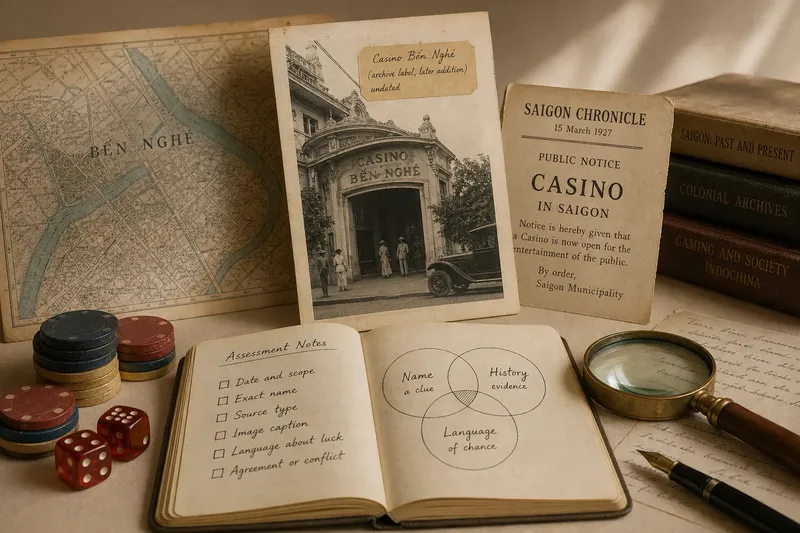
Say you are preparing a short museum caption and have three invented items: a map bearing the name Bến Nghé, an undated photograph labelled “Casino Bến Nghé” by a later archive, and a dated newspaper notice about a casino in Saigon that does not name this subject. The map supports a place-name connection; the photograph’s archive label is not yet a confirmed identification; and the notice cannot connect its casino reference to the photographed building. A caption could therefore say that the archive labels the undated photograph “Casino Bến Nghé”, while the identification and date remain uncertain. That wording communicates what the items say without claiming they establish one continuous history.
Use these checks when assessing a source. Each observation points to a decision:
- Check the date and its scope: if the source dates a specific event or object, state that scope; if the date is missing or unclear, mark the timing unknown and avoid assigning one.
- Check the exact name: if the source names Casino Bến Nghé, report that direct identification with its source; if it names only a casino in Saigon, do not attach it to this subject without separate evidence.
- Check the source type: if a map labels a place, use it for the label and geography it shows; if a memoir or notice describes an event, assess what that writer could know and avoid treating it as a map.
- Check the image caption: if the caption’s date and provenance are documented, preserve them; if a later archive supplied the label, identify it as a later label and leave the identification open.
- Check who uses language about luck: if a source attributes the phrase to a speaker, quote or paraphrase it as that person’s view; if the speaker is unknown, describe the wording without assigning a belief.
- Check whether sources agree: if independent sources support the same limited point, state that point; if they conflict, report the disagreement and leave the disputed detail unresolved.
Casino Bến Nghé is best approached by separating a name, a documented history and the images or expressions of chance attached to it. That method makes a short account more useful: readers can see what is stated, what is interpretation and what further evidence would be needed to make a stronger claim.